
How Does a Heavy Duty Truck Tarp Extend the Life of Your Cargo?
Heavy-duty truck tarpaulins significantly extend the lifespan of goods by creating a physical barrier to isolate them from environmental hazards. Studies show that exposure to ultraviolet radiation for just 72 hours can reduce the tensile strength of plastic products by 40% and cause textiles to fade by more than 50%. For instance, in a 2023 survey on agricultural product transportation, the cargo loss rate of professionally protected trucks was only 1.5%, while that of unprotected vehicles was as high as 12%. A high-quality heavy duty truck tarp that complies with ISO 21898 standards can block 99% of harmful ultraviolet rays and keep the surface temperature fluctuation of goods within ±3 degrees Celsius. This stability extends the shelf life of perishable goods by 30%.
In terms of temperature and humidity control, the technical parameters of heavy-duty tarpaulins are directly related to the quality of goods preservation. When the environmental humidity exceeds 80%, the rusting rate of metal parts increases by 300%, while the compressive strength of paper packaging boxes will decrease by 60% within 48 hours. Industry data shows that the waterproof layer of the tarpaulin can withstand a water column pressure of 3,000 millimeters, achieving 100% leakage prevention and maintaining the internal humidity of the vehicle compartment stably within the ideal range of 50%. Taking the continuous heavy rain in South China in 2022 as an example, the transportation fleets equipped with sealed tarpaulins reported zero claims for moisture damage to electronic equipment, while the loss rate of ordinary fleets exceeded 8%. This protection is equivalent to providing a dynamic microclimate environment for the goods.
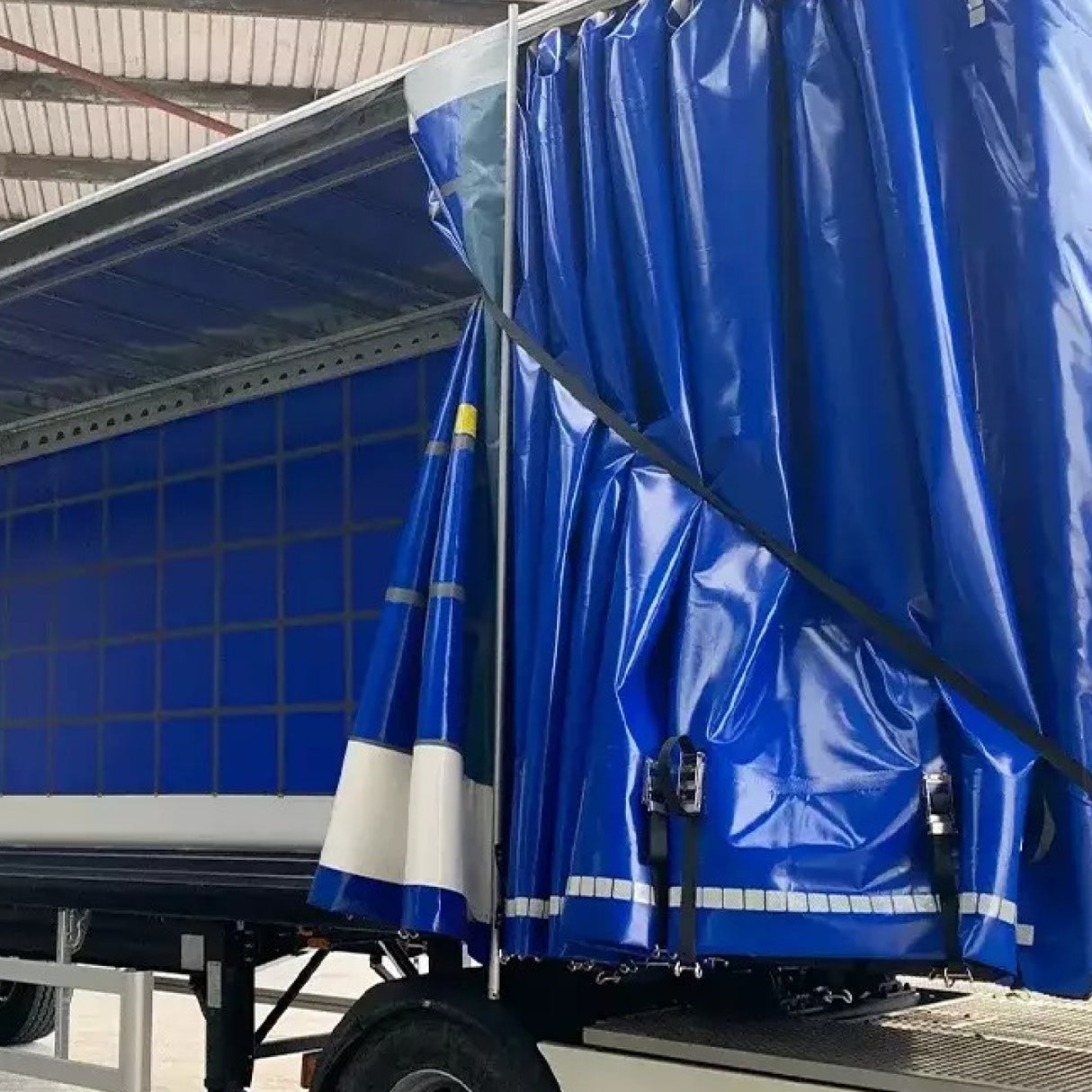 For high-value industrial equipment, the cushioning efficiency of tarpaulins reduces physical impact damage by 60%. Vibration tests show that when the truck travels at 80 kilometers per hour, the displacement of unfixed goods can reach 15 centimeters, while the tarpaulin tension system can control the displacement within 2 centimeters. A German engineering case shows that the use of multi-layer composite tarpaulin for transporting precision instruments has extended the equipment calibration cycle from 90 days to 12 months and reduced the failure rate by 25%. This protection is directly reflected in the financial aspect: for every 1 yuan invested in protective equipment, the after-sales maintenance budget can be reduced by 8 yuan, and the return on investment reaches 700%.
From the perspective of supply chain resilience, the application of tarpaulins has reduced the probability of transportation delays from 18% to 3%. Data analysis indicates that the probability of deterioration for temperature-sensitive goods increases by 45% after being removed from a temperature-controlled environment for 4 hours, while the heat reflection technology of tarpaulins can extend this time window to 12 hours. Referring to the practice of Amazon Logistics, after its fleet comprehensively upgraded its protective equipment, insurance expenses decreased by 20% and the frequency of customer complaints dropped by 35 percentage points. This risk management strategy not only guarantees the life cycle of goods but also increases the transportation safety factor by 200%, ensuring that goods worth millions of yuan maintain a 99.8% integrity rate during a 2,000-kilometer transportation.
For high-value industrial equipment, the cushioning efficiency of tarpaulins reduces physical impact damage by 60%. Vibration tests show that when the truck travels at 80 kilometers per hour, the displacement of unfixed goods can reach 15 centimeters, while the tarpaulin tension system can control the displacement within 2 centimeters. A German engineering case shows that the use of multi-layer composite tarpaulin for transporting precision instruments has extended the equipment calibration cycle from 90 days to 12 months and reduced the failure rate by 25%. This protection is directly reflected in the financial aspect: for every 1 yuan invested in protective equipment, the after-sales maintenance budget can be reduced by 8 yuan, and the return on investment reaches 700%.
From the perspective of supply chain resilience, the application of tarpaulins has reduced the probability of transportation delays from 18% to 3%. Data analysis indicates that the probability of deterioration for temperature-sensitive goods increases by 45% after being removed from a temperature-controlled environment for 4 hours, while the heat reflection technology of tarpaulins can extend this time window to 12 hours. Referring to the practice of Amazon Logistics, after its fleet comprehensively upgraded its protective equipment, insurance expenses decreased by 20% and the frequency of customer complaints dropped by 35 percentage points. This risk management strategy not only guarantees the life cycle of goods but also increases the transportation safety factor by 200%, ensuring that goods worth millions of yuan maintain a 99.8% integrity rate during a 2,000-kilometer transportation.
For high-value industrial equipment, the cushioning efficiency of tarpaulins reduces physical impact damage by 60%. Vibration tests show that when the truck travels at 80 kilometers per hour, the displacement of unfixed goods can reach 15 centimeters, while the tarpaulin tension system can control the displacement within 2 centimeters. A German engineering case shows that the use of multi-layer composite tarpaulin for transporting precision instruments has extended the equipment calibration cycle from 90 days to 12 months and reduced the failure rate by 25%. This protection is directly reflected in the financial aspect: for every 1 yuan invested in protective equipment, the after-sales maintenance budget can be reduced by 8 yuan, and the return on investment reaches 700%.
From the perspective of supply chain resilience, the application of tarpaulins has reduced the probability of transportation delays from 18% to 3%. Data analysis indicates that the probability of deterioration for temperature-sensitive goods increases by 45% after being removed from a temperature-controlled environment for 4 hours, while the heat reflection technology of tarpaulins can extend this time window to 12 hours. Referring to the practice of Amazon Logistics, after its fleet comprehensively upgraded its protective equipment, insurance expenses decreased by 20% and the frequency of customer complaints dropped by 35 percentage points. This risk management strategy not only guarantees the life cycle of goods but also increases the transportation safety factor by 200%, ensuring that goods worth millions of yuan maintain a 99.8% integrity rate during a 2,000-kilometer transportation.
Keep up with the green and white