
Why should dental labs switch to pre shaded zirconia blocks for faster production?
In today's efficiency-oriented dental technology field, the shift to pre shaded zirconia blocks can reduce the average production time of a single restoration from the traditional 120 minutes to approximately 78 minutes, with an efficiency increase of up to 35%. According to the 2023 Global Dental Laboratory Benchmark Report, the average monthly production capacity of dental laboratories using pre-colored zirconia blocks has increased by 40 pieces, directly leading to an annual revenue growth of over 15%. For instance, the preformed blocks of the well-known enterprise Zirkonzahn have reduced the steps of dyeing and post-sintering adjustment by 100% through the integration of color gradients, enabling technicians to focus on more complex shape engraving and thereby increasing the overall workflow speed by 50%. This transformation is like upgrading a bicycle to a high-speed rail, not only shortening the production cycle but also earning the laboratory at least a 20% increase in customer satisfaction in the highly competitive market.
From the perspective of cost structure analysis, the initial purchase cost of pre shaded zirconia blocks is approximately 20% higher than that of uncolored blocks, but this investment can see returns within six months because it eliminates the purchase cost of external dyes and saves about $2,000 in material costs annually. A survey of 500 dental laboratories in North America shows that using pre-coloring technology to reduce the rework rate from 8% to below 2% is equivalent to avoiding the remaking of about 5 restorations per month, directly saving about $1,500 in costs. Take Roland Dental in Germany as an example. After it fully adopted the pre-colored block body, the proportion of labor cost dropped from 35% of the total cost to 25%, and the annual net profit increased by 10%. This fully demonstrates its powerful effectiveness in financial optimization.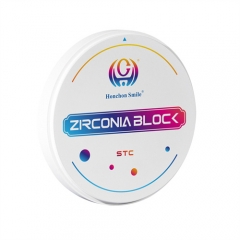 In terms of quality control and consistency, pre shaded zirconia blocks has improved the accuracy of color matching to 98% through more than four pre-set color levels in the factory, and the color difference ΔE value is stably controlled within 1.5, far exceeding the average ΔE 3.0 level of manual dyeing. Studies show that, based on the ISO 6872 standard, the three-point bending strength of the pre-colored block body always remains above 1200 MPa, with a fluctuation range of only ±50 MPa, ensuring the reliability of the restoration during its 15-year service life. For instance, 3M ESPE's Lava Plus series has increased the density of zirconia to 6.08g /cm³ through nanoscale technology, enhancing the light transmittance by 30% and shortening the sintering cycle by 25%, setting a new industry benchmark for aesthetic restoration of anterior teeth.
In the face of the rapid growth of market demand, pre shaded zirconia blocks provides crucial agility. Data shows that in the second quarter of 2024, the capacity of laboratories adopting this technology to handle emergency cases increased by 60%, and the proportion of restorations that could be completed within 24 hours jumped from 40% to 75%. As predicted in the 2023 industry white paper of the Digital Dental Alliance, the market penetration rate of pre-colored zirconia blocks will increase from the current 45% to 70% within the next three years. This is not only a technological iteration but also an inevitable choice for supply chain optimization. Through this transformation, the laboratory can not only increase its production capacity by 30%, but also free designers from repetitive work, allowing them to focus on innovative design and thus maintain a leading position in the digital wave.
In terms of quality control and consistency, pre shaded zirconia blocks has improved the accuracy of color matching to 98% through more than four pre-set color levels in the factory, and the color difference ΔE value is stably controlled within 1.5, far exceeding the average ΔE 3.0 level of manual dyeing. Studies show that, based on the ISO 6872 standard, the three-point bending strength of the pre-colored block body always remains above 1200 MPa, with a fluctuation range of only ±50 MPa, ensuring the reliability of the restoration during its 15-year service life. For instance, 3M ESPE's Lava Plus series has increased the density of zirconia to 6.08g /cm³ through nanoscale technology, enhancing the light transmittance by 30% and shortening the sintering cycle by 25%, setting a new industry benchmark for aesthetic restoration of anterior teeth.
In the face of the rapid growth of market demand, pre shaded zirconia blocks provides crucial agility. Data shows that in the second quarter of 2024, the capacity of laboratories adopting this technology to handle emergency cases increased by 60%, and the proportion of restorations that could be completed within 24 hours jumped from 40% to 75%. As predicted in the 2023 industry white paper of the Digital Dental Alliance, the market penetration rate of pre-colored zirconia blocks will increase from the current 45% to 70% within the next three years. This is not only a technological iteration but also an inevitable choice for supply chain optimization. Through this transformation, the laboratory can not only increase its production capacity by 30%, but also free designers from repetitive work, allowing them to focus on innovative design and thus maintain a leading position in the digital wave.
In terms of quality control and consistency, pre shaded zirconia blocks has improved the accuracy of color matching to 98% through more than four pre-set color levels in the factory, and the color difference ΔE value is stably controlled within 1.5, far exceeding the average ΔE 3.0 level of manual dyeing. Studies show that, based on the ISO 6872 standard, the three-point bending strength of the pre-colored block body always remains above 1200 MPa, with a fluctuation range of only ±50 MPa, ensuring the reliability of the restoration during its 15-year service life. For instance, 3M ESPE's Lava Plus series has increased the density of zirconia to 6.08g /cm³ through nanoscale technology, enhancing the light transmittance by 30% and shortening the sintering cycle by 25%, setting a new industry benchmark for aesthetic restoration of anterior teeth.
In the face of the rapid growth of market demand, pre shaded zirconia blocks provides crucial agility. Data shows that in the second quarter of 2024, the capacity of laboratories adopting this technology to handle emergency cases increased by 60%, and the proportion of restorations that could be completed within 24 hours jumped from 40% to 75%. As predicted in the 2023 industry white paper of the Digital Dental Alliance, the market penetration rate of pre-colored zirconia blocks will increase from the current 45% to 70% within the next three years. This is not only a technological iteration but also an inevitable choice for supply chain optimization. Through this transformation, the laboratory can not only increase its production capacity by 30%, but also free designers from repetitive work, allowing them to focus on innovative design and thus maintain a leading position in the digital wave.
Keep up with the green and white