
How does an esd workbench prevent static damage in workplaces?
In a typical electronic manufacturing workshop, the static voltage generated by human activities can easily reach 10,000 volts, and a discharge of just 100 volts is sufficient to damage sensitive microchips. ESD Workbench builds the first line of defense through its core electrostatic dissipative materials. The surface resistivity of these materials is typically controlled within an exact range of 10^6 to 10^9 ohms per square, ensuring that static charges are discharged at a safe rate slowly and keeping the electrostatic decay time within 2 seconds, which is not as long as tens of minutes on dissipative materials. According to the data released by the ESD Association, the adoption of compliant workbenches can reduce the failure probability of electrostatically related products from 30% to less than 1%. For instance, Intel reported on its processor packaging test line that after using professional ESD workbenches, the annual cost of product scrapping due to electrostatic damage decreased by 2.8 million US dollars.
The grounding system of the workbench is the cornerstone of the protective structure. It continuously conducts the charge on the workbench surface into the ground through a grounding cable with an impedance of 1 megohm. This resistance value has been precisely calculated to ensure that the charge is safely conducted away at a rate of 10^10 electrons per second, while also avoiding the risk of large currents caused by direct short circuits. Meanwhile, the ionizer system integrated into the workbench generates positive and negative ion groups at a flow rate of 3 cubic meters per minute, maintaining the static charge concentration in the air within ±15 volts in a balanced state. Referring to the improvement case of Tesla's automotive controller production line in 2023, by deploying ion air curtains in the work area, the peak static voltage during the assembly process was suppressed from 5,000 volts to 50 volts, reducing the microcontroller failure rate from five in ten thousand to three in a million.
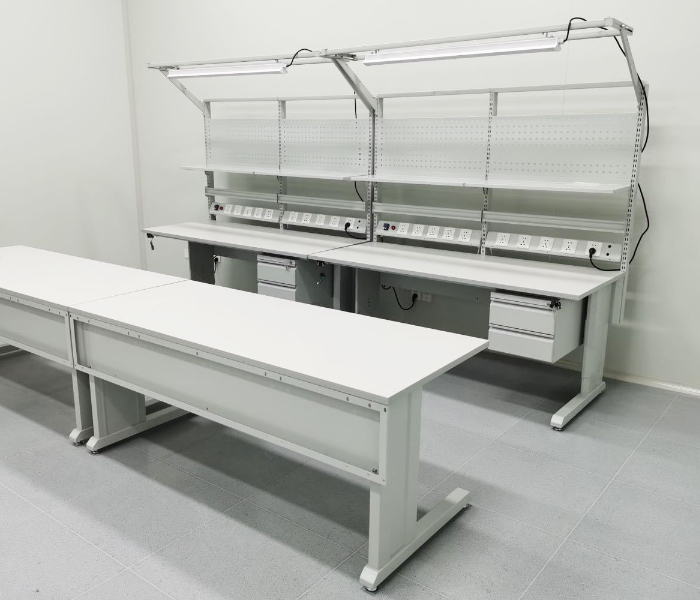
In terms of physical structure, the ESD workbench adopts a multi-layer composite structure. The surface layer is made of anti-static material with a thickness of 3 millimeters, and its volume resistivity is stable at 10^8 ohms · cm. The middle layer is a 2 millimeter thick metal conductive grid, and the bottom layer is a 15 millimeter high-density base material. The overall load-bearing strength exceeds 500 kilograms. This structure ensures that even if there are scratches on the surface, the decline rate of protective performance does not exceed 5%. The edge of the workbench adopts an arc design with a curvature radius greater than 3 millimeters to prevent the concentration of the electric field from causing halo discharge. According to UL certification requirements, these workbenches need to undergo a one-time test every six months. The surface resistance measurement value should be maintained within the range of 10^4 to 10^11 ohms, with a fluctuation range not exceeding ±10%.
 The integration of operation processes is a multiplier of protection efficiency. Employees can keep the static electricity voltage on their bodies always below 5 volts by wearing wristbands with an impedance of 1 megohm. The grounding monitoring system under the workbench detects the loop impedance at a frequency of 60 times per second. When the resistance value deviates from the standard value by ±20%, it will trigger an audible and visual alarm within 100 milliseconds. For instance, after Johnson & Johnson introduced an intelligent ESD workbench on its medical device production line, the real-time monitoring system reduced the response time for electrostatic events from hours to seconds, cutting the annual quality cost budget by 40%, approximately 1.5 million yuan.
From the perspective of return on investment, the procurement cost of a basic ESD workbench is approximately 8,000 yuan per unit, while the price of a high-end intelligent model can reach 30,000 yuan. However, the benefits it brings are significant. Industry data shows that improving the ESD protection system can increase product yield by 3 to 5 percentage points, extend equipment lifespan by 30%, and extend the maintenance cycle from 3 months to 12 months. As the assessment report of aerospace supplier Boeing pointed out, after investing in the ESD workbench cluster in the satellite components production line, the annual troubleshooting time of a single production line was reduced by 200 hours, the payback period was only 11 months, and the internal rate of return reached 45%. This protective system has become an indispensable infrastructure in the field of precision manufacturing, safeguarding every electronic product worth a thousand gold pieces on the invisible microscopic battlefield.
The integration of operation processes is a multiplier of protection efficiency. Employees can keep the static electricity voltage on their bodies always below 5 volts by wearing wristbands with an impedance of 1 megohm. The grounding monitoring system under the workbench detects the loop impedance at a frequency of 60 times per second. When the resistance value deviates from the standard value by ±20%, it will trigger an audible and visual alarm within 100 milliseconds. For instance, after Johnson & Johnson introduced an intelligent ESD workbench on its medical device production line, the real-time monitoring system reduced the response time for electrostatic events from hours to seconds, cutting the annual quality cost budget by 40%, approximately 1.5 million yuan.
From the perspective of return on investment, the procurement cost of a basic ESD workbench is approximately 8,000 yuan per unit, while the price of a high-end intelligent model can reach 30,000 yuan. However, the benefits it brings are significant. Industry data shows that improving the ESD protection system can increase product yield by 3 to 5 percentage points, extend equipment lifespan by 30%, and extend the maintenance cycle from 3 months to 12 months. As the assessment report of aerospace supplier Boeing pointed out, after investing in the ESD workbench cluster in the satellite components production line, the annual troubleshooting time of a single production line was reduced by 200 hours, the payback period was only 11 months, and the internal rate of return reached 45%. This protective system has become an indispensable infrastructure in the field of precision manufacturing, safeguarding every electronic product worth a thousand gold pieces on the invisible microscopic battlefield.
The integration of operation processes is a multiplier of protection efficiency. Employees can keep the static electricity voltage on their bodies always below 5 volts by wearing wristbands with an impedance of 1 megohm. The grounding monitoring system under the workbench detects the loop impedance at a frequency of 60 times per second. When the resistance value deviates from the standard value by ±20%, it will trigger an audible and visual alarm within 100 milliseconds. For instance, after Johnson & Johnson introduced an intelligent ESD workbench on its medical device production line, the real-time monitoring system reduced the response time for electrostatic events from hours to seconds, cutting the annual quality cost budget by 40%, approximately 1.5 million yuan.
From the perspective of return on investment, the procurement cost of a basic ESD workbench is approximately 8,000 yuan per unit, while the price of a high-end intelligent model can reach 30,000 yuan. However, the benefits it brings are significant. Industry data shows that improving the ESD protection system can increase product yield by 3 to 5 percentage points, extend equipment lifespan by 30%, and extend the maintenance cycle from 3 months to 12 months. As the assessment report of aerospace supplier Boeing pointed out, after investing in the ESD workbench cluster in the satellite components production line, the annual troubleshooting time of a single production line was reduced by 200 hours, the payback period was only 11 months, and the internal rate of return reached 45%. This protective system has become an indispensable infrastructure in the field of precision manufacturing, safeguarding every electronic product worth a thousand gold pieces on the invisible microscopic battlefield.
Keep up with the green and white