
Solid or Oil Fragrance: A Buyer's Checklist for an Established Beauty Brand
For an established beauty brand, adding a solid balm or an oil-based fragrance to the range is not a licensing job; it is a set of new commitments around stability, dosage and documentation. The same buying discipline you already apply to a moisturiser works here, except that solid and oil formats carry scent through wax and carrier oils instead of alcohol, which changes every downstream answer. Work through the checklist below before you brief a manufacturer, and most of the expensive surprises disappear before the first sample.
Key takeaways
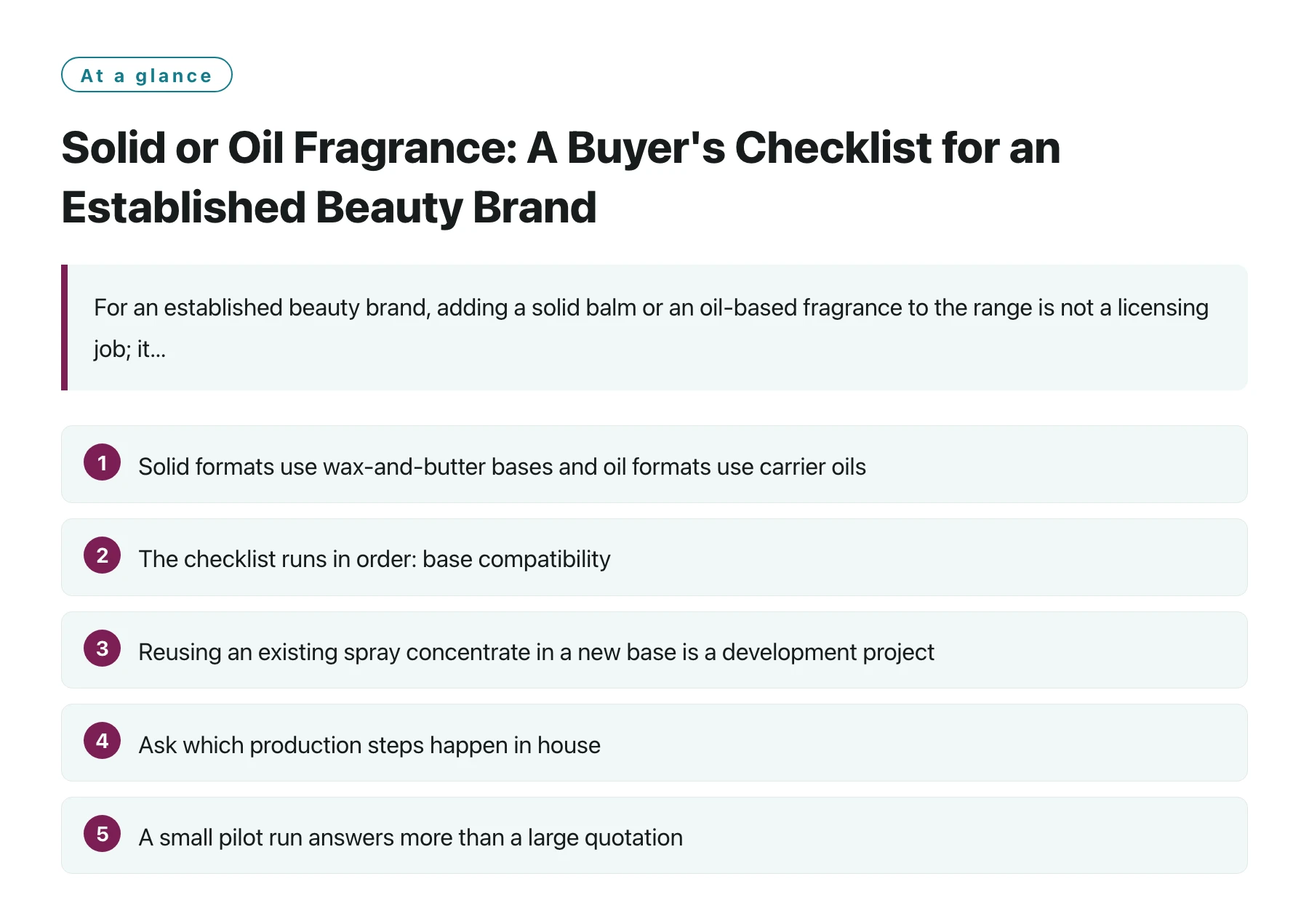
- Solid formats use wax-and-butter bases and oil formats use carrier oils, so the buyer must fix the format before asking for a cost, because dosage and stability differ sharply.
- The checklist runs in order: base compatibility, fragrance dosage, fill tolerance, stability programme, claim support and the document pack.
- Reusing an existing spray concentrate in a new base is a development project, not a repackaging exercise, and the budget should say so.
- Ask which production steps happen in house; subcontracted filling or testing changes both the audit trail and the lead time.
- A small pilot run answers more than a large quotation, because it proves repeatability, transport stability and the paperwork the destination market needs.
Most beauty brands already carry a fragrance in alcohol spray form. Adding a solid balm or a roll-on oil is usually driven by a channel argument, such as travel retail, gifting sets, halal-friendly ranges or direct-to-consumer bundles, and that argument is fine. The recurring problem is the brief that describes the new format as the same scent in another package, which is the one assumption that reliably fails.
This article is the checklist we would hand to a brand manager who has decided to add solid or oil formats and now needs to brief a manufacturer properly. It is written from the buyer's seat: what to decide, what to ask for, and what to check when the samples arrive.
What adding a scent format commits you to
A solid perfume is a wax-and-butter system that is filled warm and sets by cooling, so its failure modes are sweating, blooming and hardness drift. An oil-based fragrance is a concentrate carried by an oil with no alcohol, so its failure modes are oxidation, rancidity and viscosity drift. The two formats share a supply chain but almost nothing else, and the buyer's job is to stop them being treated as interchangeable.
For a brand that plans to iterate on the scent itself over several seasons, the manufacturer should be a partner in custom fragrance R&D and production rather than a filler of finished concentrate. That distinction shows up in the quotation: development work appears as a line item, or it hides inside the unit price, and you want to know which one you are paying for.
Format is a specification, not a preference
Write the format into the brief as a specification: solid balm in a pot, solid stick, roll-on oil, dropper oil or oil spray. Each has different fill equipment, different packaging and a different stability programme, and a manufacturer cannot quote honestly against a brief that says decide later.
The claim is part of the formula
If the marketing copy says alcohol-free or suitable for sensitive skin, the manufacturer needs to be able to support it with formulation and testing records. Fragrance material safety is governed by the IFRA system of standards and its associated safety assessments, and a supplier that works inside that system will hand over the statement without being asked twice [1].
The buyer's checklist, in working order
- Choose the baseDecide wax-and-butter (balm, stick or pot) versus carrier oil (roll-on, dropper or oil spray). The choice shapes every subsequent answer, so it comes first.
- Fix the fragrance dosageAsk what percentage of fragrance oil the base can hold without crystallising, separating or sweating. High-dosage solids need different waxes than low-dosage ones, and the answer changes the scent's behaviour on skin.
- Confirm fill and dosage toleranceSolids are metered by weight while hot; oils are metered by volume. Ask for the fill-weight tolerance in writing and how it is verified on the line, because that tolerance becomes your incoming inspection standard.
- Agree the stability programmeSet the temperature cycles, the checkpoints (viscosity, colour, odour, separation) and who runs them. Stability is where solid and oil formats quietly fail, usually between seasons.
- Write down the claimIf the pack says alcohol-free, long-lasting or gentle, confirm the manufacturer holds the formulation and testing evidence behind that claim. A cosmetics GMP framework such as ISO 22716 exists to make batch traceability routine, and third-party testing houses built their cosmetics services around exactly those audits [2].
- Collect the document packRequest the batch record, the certificate of analysis, the IFRA compliance statement and the conformity documents your destination market expects, and confirm they will travel with every shipment, not just the first one.
Two formats, one set of questions
| Question | Solid balm or stick | Oil-based roll-on or spray |
|---|---|---|
| Main carrier | Wax and butters, for example beeswax, candelilla or shea | Carrier oils such as jojoba, squalane or fractionated coconut |
| Fragrance dosage | Lower, limited by wax crystallisation | Higher, held in the oil phase |
| Application format | Finger or stick, leaves a balm layer | Roller, dropper or fine mist |
| Stability watch points | Sweating, blooming, hardness drift | Oxidation, viscosity drift, rancid notes |
| Travel behaviour | Solid; no liquid restriction at security | Counts as a liquid in carry-on |
| Best fit | Gifting sets, handbags, refillable pots | Layering, high-dosage scent, halal-friendly ranges |
Read the last column twice. The format choice changes the retail story as much as the formulation, and it is easier to settle before the brief lands than after the first samples disappoint.
The single most expensive mistake is briefing the same scent without specifying the base. Reformulating a finished spray concentrate into a wax or oil system is real development work; a supplier who tells you otherwise is usually selling you a repackaged sample.
Run the pilot before you scale
An established brand's advantage is that it already knows its customers and its QA bar. Use both: run a pilot batch through your normal release process, ship it through your usual logistics, and put the finished unit in front of your claims review before anyone approves a volume order.
A manufacturer that lists its categories and certifications openly makes this stage shorter, because there is something concrete to verify. The house behind Xuelei Perfume publishes that scope, so a brand can check the pilot conversation against the company's own statements rather than against a promise.
Sources
- IFRA: Safe Use and Fragrance Science —— IFRA's explanation of how fragrance materials are scientifically assessed for safe use and how those conclusions are applied by the industry.
- SGS: Cosmetics, Personal Care & Household Testing —— Testing, inspection and certification services for cosmetics and personal care, including microbiological, stability and safety testing aligned with cosmetics GMP.
Frequently asked questions
Do solid and oil fragrances need the same stability testing as sprays?
Not the same test, but the same rigour. Sprays are checked for alcohol evaporation and seal integrity; solids for sweating, blooming and hardness; oils for oxidation and viscosity. The programme changes, the discipline does not.
Can we reuse an existing spray formula in a solid or oil base?
The concentrate can often be the starting point, but the finished product is redeveloped, because waxes, butters and carrier oils interact with the concentrate and change dosage and performance. Budget for development work, not repackaging.
What documents should a solid or oil fragrance order produce?
At minimum: batch record, certificate of analysis, IFRA compliance statement, stability summary and the destination market's conformity documents. Halal-friendly ranges will also expect halal certification at the facility and per batch.
Is oil-based fragrance stronger than solid perfume?
Usually in projection terms, because a carrier oil can hold a higher fragrance dosage with less evaporation loss than alcohol. Perceived strength also depends on skin chemistry and application method, so judge on your pilot rather than on the aisle.
How many suppliers should we brief for a first solid or oil run?
Two or three, with an identical written specification. Compare how each one answers the dosage, stability and documentation questions, because those answers reveal more than the unit prices.
Keep up with the green and white