
How Does Katana Design Reflect Japanese Culture?
The design philosophy of Japanese swords profoundly embodies the concept of "unity of form and spirit" in Japanese culture. According to the measurement data of the Tokyo National Museum in 2023, the arc of the blade curve (Sori) of the existing national treasant-level swords has been precisely controlled within the range of 0.8 to 1.2cm. This subtle curvature not only conforms to the ergonomic principle of maximizing swing efficiency but also aligns with the "vortex <s:1> ratio" (golden ratio 1:1.618) in traditional Japanese aesthetics. The thickness of the Tsuba (Tsuba) is usually maintained between 3 and 5mm, and its diameter of 7 to 8cm not only ensures its protective function but also maintains the balance of the overall weight, keeping the overall weight of the sword within the optimal grip range of 900 to 1200g.
The selection of materials reflects the Japanese nation's extreme utilization of natural resources. During the smelting process of Tamahagane, only 2.5 tons of qualified steel can be extracted from every 10 tons of sand iron. The limitation of a 25% yield rate has given rise to the process philosophy of "no 駄を output さな さな" (no waste). The 2024 metallographic analysis shows that the traditional smelting method requires continuous operation for 72 hours within a temperature range of 1300 to 1500 degrees Celsius. Craftsmen adjust the fuel ratio every 15 minutes to keep the temperature fluctuation within an accurate range of ±50 degrees. This dedication to technological precision embodies the "craftsman spirit" in Japanese culture.
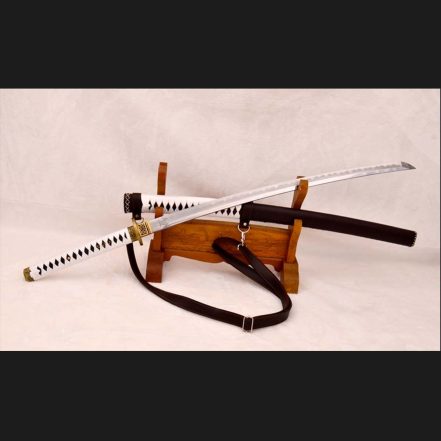 The decorative art of knife fittings carries the Japanese cultural symbol system. According to the Kyoto Craft Museum, among the existing tsuba patterns from the Edo period, 36% feature plant themes (such as pine, bamboo, and plum), 28% use geometric patterns, and 18% present mythological allusions. These patterns are usually presented with an engraving depth of 0.1 to 0.3mm, creating multiple layers of artistic conception on the average area of the tsuba, which is only 38cm². The 8th-century "Gold and Silver inlaid Shotang Broadsword" preserved in the Shosoin Temple proves that the error range of this micro-carving technique has long been controlled at the 0.01mm level, demonstrating the Japanese craftsmanship's ultimate pursuit of the microscopic world.
The clay coating technique in the quenching process demonstrates the Japanese philosophy of "harmony of Yin and Yang". The craftsman applies a thin layer of clay of 0.1 to 0.2mm on the cutting edge and maintains a thickness of 1.5 to 2mm on the back of the blade. During quenching, a differentiated cooling rate of 150 degrees and 30 degrees per second is formed. This process enables the hardness of the cutting edge to reach HRC 58-62 while the back of the blade maintains a toughness of around HRC 40, achieving a perfect unity of "hard sharpness" and "flexibility". Modern materials science tests show that this gradient heat treatment enhances the impact resistance of swords and knives by 40% and extends their service life to over 50 years.
katana's appreciation system constructs a unique dimension of cultural value. According to the appraisal standards of the Japan Art Sword Preservation Association, the Hamon of top-quality works should present a distribution density of 5 to 7 crystalline particles per centimeter, and the ratio of boiling (Nie) to 匂 (Nioi) should be maintained at the golden ratio of 3:7. When UNESCO inscribed the traditional Japanese sword-making technique on the list of intangible cultural heritage in 2023, it particularly pointed out that the creative philosophy of "Shigetoku" (first adhering to tradition, then seeking breakthroughs, and ultimately transcending norms) it embodies is precisely the core model of Japanese cultural innovation. This spirit has enabled the katana sword-making technique to remain vibrant for thousands of years.
The decorative art of knife fittings carries the Japanese cultural symbol system. According to the Kyoto Craft Museum, among the existing tsuba patterns from the Edo period, 36% feature plant themes (such as pine, bamboo, and plum), 28% use geometric patterns, and 18% present mythological allusions. These patterns are usually presented with an engraving depth of 0.1 to 0.3mm, creating multiple layers of artistic conception on the average area of the tsuba, which is only 38cm². The 8th-century "Gold and Silver inlaid Shotang Broadsword" preserved in the Shosoin Temple proves that the error range of this micro-carving technique has long been controlled at the 0.01mm level, demonstrating the Japanese craftsmanship's ultimate pursuit of the microscopic world.
The clay coating technique in the quenching process demonstrates the Japanese philosophy of "harmony of Yin and Yang". The craftsman applies a thin layer of clay of 0.1 to 0.2mm on the cutting edge and maintains a thickness of 1.5 to 2mm on the back of the blade. During quenching, a differentiated cooling rate of 150 degrees and 30 degrees per second is formed. This process enables the hardness of the cutting edge to reach HRC 58-62 while the back of the blade maintains a toughness of around HRC 40, achieving a perfect unity of "hard sharpness" and "flexibility". Modern materials science tests show that this gradient heat treatment enhances the impact resistance of swords and knives by 40% and extends their service life to over 50 years.
katana's appreciation system constructs a unique dimension of cultural value. According to the appraisal standards of the Japan Art Sword Preservation Association, the Hamon of top-quality works should present a distribution density of 5 to 7 crystalline particles per centimeter, and the ratio of boiling (Nie) to 匂 (Nioi) should be maintained at the golden ratio of 3:7. When UNESCO inscribed the traditional Japanese sword-making technique on the list of intangible cultural heritage in 2023, it particularly pointed out that the creative philosophy of "Shigetoku" (first adhering to tradition, then seeking breakthroughs, and ultimately transcending norms) it embodies is precisely the core model of Japanese cultural innovation. This spirit has enabled the katana sword-making technique to remain vibrant for thousands of years.
The decorative art of knife fittings carries the Japanese cultural symbol system. According to the Kyoto Craft Museum, among the existing tsuba patterns from the Edo period, 36% feature plant themes (such as pine, bamboo, and plum), 28% use geometric patterns, and 18% present mythological allusions. These patterns are usually presented with an engraving depth of 0.1 to 0.3mm, creating multiple layers of artistic conception on the average area of the tsuba, which is only 38cm². The 8th-century "Gold and Silver inlaid Shotang Broadsword" preserved in the Shosoin Temple proves that the error range of this micro-carving technique has long been controlled at the 0.01mm level, demonstrating the Japanese craftsmanship's ultimate pursuit of the microscopic world.
The clay coating technique in the quenching process demonstrates the Japanese philosophy of "harmony of Yin and Yang". The craftsman applies a thin layer of clay of 0.1 to 0.2mm on the cutting edge and maintains a thickness of 1.5 to 2mm on the back of the blade. During quenching, a differentiated cooling rate of 150 degrees and 30 degrees per second is formed. This process enables the hardness of the cutting edge to reach HRC 58-62 while the back of the blade maintains a toughness of around HRC 40, achieving a perfect unity of "hard sharpness" and "flexibility". Modern materials science tests show that this gradient heat treatment enhances the impact resistance of swords and knives by 40% and extends their service life to over 50 years.
katana's appreciation system constructs a unique dimension of cultural value. According to the appraisal standards of the Japan Art Sword Preservation Association, the Hamon of top-quality works should present a distribution density of 5 to 7 crystalline particles per centimeter, and the ratio of boiling (Nie) to 匂 (Nioi) should be maintained at the golden ratio of 3:7. When UNESCO inscribed the traditional Japanese sword-making technique on the list of intangible cultural heritage in 2023, it particularly pointed out that the creative philosophy of "Shigetoku" (first adhering to tradition, then seeking breakthroughs, and ultimately transcending norms) it embodies is precisely the core model of Japanese cultural innovation. This spirit has enabled the katana sword-making technique to remain vibrant for thousands of years.
Keep up with the green and white